The days of fumbling for physical car keys are rapidly coming to an end. Apple is currently spearheading a massive collaborative effort with automotive giants to refine and launch the next generation of Apple Car Key. By joining forces with the Car Connectivity Consortium (CCC), Apple is ensuring that unlocking your vehicle with an iPhone or Apple Watch is not just a luxury feature, but a seamless, industry-wide standard. With major players like Tesla, BMW, and Rivian involved in rigorous testing, 2025 is shaping up to be the year the digital key goes mainstream.
The Next Generation: CCC Digital Key Version 4.0
The current buzz in the tech-auto world centers on the transition to CCC Digital Key Version 4. This isn’t just a minor update; it is a complete overhaul designed to fix the “manufacturer quirks” that sometimes plague digital systems.
- Universal Compatibility: Version 4 focuses on cross-platform communication, meaning your iPhone will work just as reliably with a Hyundai as it does with a Mercedes-Benz.
- Enhanced Security: New protocols provide hardware-level cryptographic protection.
- Battery Optimization: The system is designed to be lighter on your device’s battery life while maintaining a constant, secure connection.
- Backward Compatibility: Rigorous testing ensures that new Version 4 devices (like the iPhone 16) will still work perfectly with older Version 3 vehicles.
Tesla’s Major Shift: Embracing the Apple Ecosystem
Perhaps the biggest news in this space is Tesla’s move toward industry-standard digital keys. Historically, Tesla has preferred its own proprietary Bluetooth-based system. However, recent code discoveries in Tesla’s app suggest the company is preparing for official Apple Wallet integration.
This is a game-changer for Tesla owners. Currently, Tesla’s “Phone Key” relies on the app running in the background. If the phone kills the app to save power, you might find yourself locked out. By using Apple Car Key, the digital credential lives in the iPhone’s Secure Enclave. This allows the key to function independently of any app and even works for up to five hours after your iPhone battery dies via Power Reserve mode.
How It Works: NFC vs. Ultra-Wideband (UWB)
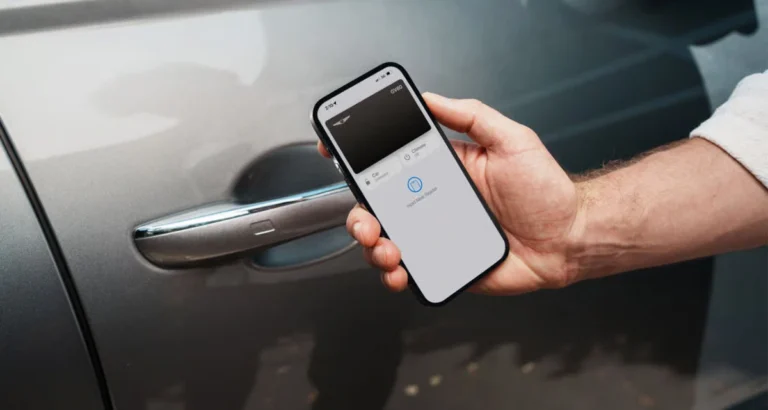
Apple Car Key utilizes two primary technologies to bridge the gap between your pocket and your car’s door handle:
| Technology | How it Works | Best For |
| NFC (Near Field Communication) | Requires you to tap your phone against the door handle. | Reliability, even when the phone battery is nearly dead. |
| Ultra-Wideband (UWB) | Precisely tracks your phone in 3D space; the car unlocks as you walk up. | Hands-free “Passive Entry” and superior theft protection. |
UWB technology is the gold standard, providing centimeter-level accuracy. It prevents “relay attacks” (where thieves intercept a signal) because the car knows exactly where the phone is—whether it’s in your hand at the driver’s side or inside the house on a kitchen counter.
Manufacturers Leading the 2025 Rollout
While BMW was the pioneer, launching support back in 2020, the roster of participating manufacturers has exploded. At WWDC 2025, Apple confirmed that 13 additional brands are joining the fold.
- Luxury & Performance: Porsche, Mercedes-Benz (2024 E-Class), and Lucid Motors are integrating high-end UWB features.
- Mainstream & SUVs: Hyundai and Genesis have expanded support from premium sedans to their entire volume lineups, including the IONIQ 6 and Palisade.
- American Trucks: In a significant milestone, RAM has become the first American full-size pickup to support Apple Car Key with the 2025 RAM 1500.
- The Global Market: The CCC has already certified over 115 digital key products this year, including the first compatible vehicles in China.
The Future: Key Sharing and Fleet Management
The evolution of Apple Car Key isn’t just about unlocking doors; it’s about how we share our vehicles. Through iMessage, users can now share “digital keys” with friends or family with specific permissions.
For example, a parent can send a key to a teenage driver that allows them to unlock and drive the car but sets a speed limit. Alternatively, you could send a temporary “unlock only” key to a delivery person or a mechanic. As we move into 2026, this technology will likely become the standard for rental car agencies and car-sharing services, making the physical key a relic of the past.