
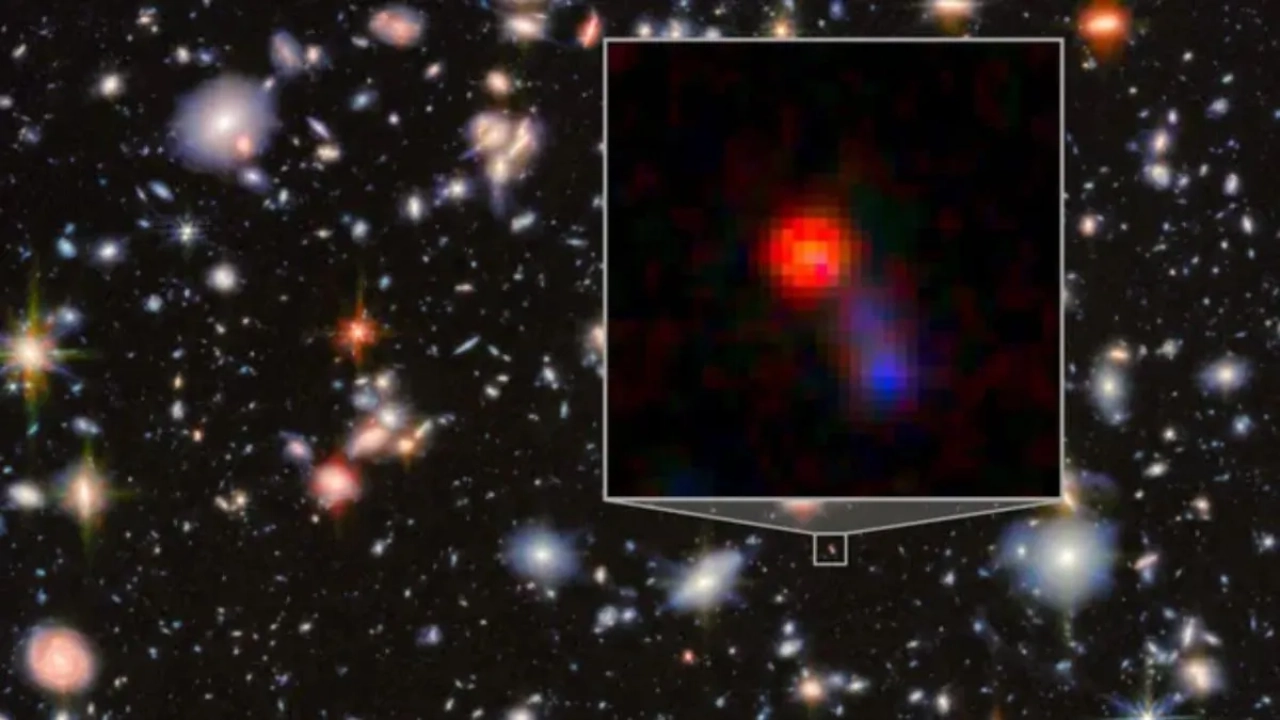
For decades, the study of galaxy formation was like looking at a finished puzzle without knowing how the pieces fit. However, the James Webb Space Telescope (JWST) has just revealed a cosmic anomaly that is forcing scientists to rethink everything. Nicknamed the “Jekyll and Hyde” system, a galaxy known as Virgil has been caught living a double life: appearing as a peaceful star-forming hub on the outside while harboring a monstrous, energy-spewing secret within.
A Dual Personality in Deep Space
The nickname “Jekyll and Hyde” isn’t just for flair; it describes the galaxy’s literal two-sided nature. When viewed through ultraviolet and optical light, Virgil appears “mild-mannered”—a typical galaxy quietly producing stars. However, hidden deep beneath layers of cosmic dust lies a supermassive black hole of incredible proportions.
What makes this discovery particularly jarring for astronomers is the scale. The black hole is considered “overmassive,” meaning it is far larger than it should be relative to the size of its host galaxy. This imbalance challenges the long-held “co-evolution” model, which suggests that galaxies and their central black holes usually grow at a synchronized pace.
Unmasking the Monster with MIRI
The discovery was made possible by JWST’s Mid-Infrared Instrument (MIRI). While previous telescopes saw only the “good” side of Virgil, MIRI’s infrared capabilities allowed scientists to peer through the thick shroud of dust.
“UV and optical observations show the ‘good’ side, but MIRI data reveal the black hole’s intense energy output,” explained George Rieke of the University of Arizona, a co-team leader on the project.
This revelation suggests a startling possibility: many galaxies previously thought to be “ordinary” might actually be hiding massive, energy-dense black holes that are simply invisible to standard telescopes.
The Mystery of the ‘Little Red Dots’
Virgil belongs to a unique class of early-universe objects known as “Little Red Dots.” These galaxies appeared approximately 600 million years after the Big Bang. While the JWST has detected these in significant numbers, they seem to largely disappear from the cosmic record by the time the universe reached two billion years of age.
Key Facts About Virgil and Little Red Dots:
- Age: Emerged roughly 600 million years after the Big Bang.
- Classification: “Little Red Dot” (Dust-obscured, high-energy galaxies).
- The MIRI Advantage: Detects infrared light to see through cosmic dust that blocks visible light.
- The “Overmassive” Problem: The central black hole is disproportionately large compared to the surrounding stars.
Tracking the Cosmic Descendants
As these “Little Red Dots” vanish from view in the later stages of the universe, Virgil serves as a critical link for researchers. By studying this system, scientists hope to identify what these galaxies eventually turned into.
Pierluigi Rinaldi of the Space Telescope Science Institute noted that MIRI’s ability to look beyond visible light is showing us a universe we’ve never seen before. This mastery of infrared technology is not just finding “invisible monsters”—it is adding much-needed clarity to the timeline of how our universe evolved from a chaotic beginning into the structured cosmos we see today.